

What is a Magnetic Flow Meter?

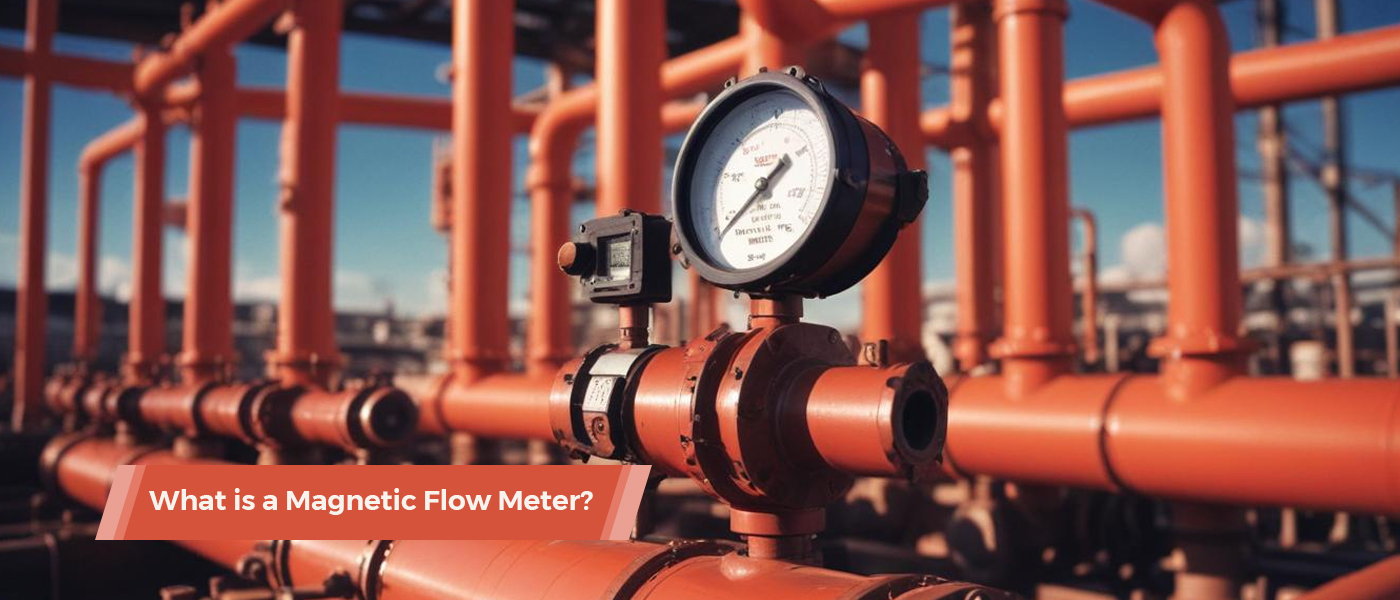
A Magnetic Flow Meter, also known as a magmeter, is a type of flow measurement device used to measure the velocity of conductive fluids in a pipe. This device works on the principle of Faraday's Law of Electromagnetic Induction, which states that a voltage is induced when a conductor moves through a magnetic field. In the case of a magnetic flow meter, the conductive fluid acts as the conductor.
How Does a Magnetic Flow Meter Work?
Principle of Operation
Magnetic flow meters generate a magnetic field through coils located outside the flow tube. When a conductive fluid passes through this magnetic field, it induces a voltage. Electrodes positioned on the inside walls of the flow tube measure this voltage, which is proportional to the fluid's velocity.Key Equation
E=k⋅B⋅v⋅DE = k \cdot B \cdot v \cdot DE=k⋅B⋅v⋅D
The voltage induced (EEE) can be expressed as:Where:
- kkk is a constant
- BBB is the magnetic field strength
- vvv is the velocity of the fluid
- DDD is the pipe diameter
Output
The measured voltage is converted into a flow rate reading, which can be displayed on a screen or transmitted to a monitoring system.
Key Features of Magnetic Flow Meters
- Non-Invasive Measurement: No moving parts or obstructions in the flow path, making it suitable for clean and dirty fluids.
- High Accuracy: Typically provides accuracy within ±0.5% of the flow rate.
- Versatility: Can measure a wide range of fluids, such as water, chemicals, slurries, and wastewater, as long as they are conductive.
- Durability: Ideal for corrosive and abrasive fluids due to the use of durable lining materials like PTFE or rubber.
Applications of Magnetic Flow Meters
Magnetic flow meters are widely used in various industries, including:
- Water and Wastewater: Monitoring water supply, sewage treatment, and stormwater management.
- Chemical Processing: Measuring the flow of corrosive chemicals and solutions.
- Food and Beverage: Ensuring precise measurement of liquids like milk, juices, and syrups.
- Pharmaceutical: Monitoring the flow of highly purified water and other solutions.
- Mining and Minerals: Measuring slurry flow in mining operations.
Advantages of Magnetic Flow Meters
- No Pressure Loss: As there are no obstructions, they maintain the pipeline's original flow capacity.
- Long Lifespan: Resistant to wear and tear due to the absence of moving parts.
- Maintenance-Free: Minimal maintenance requirements.
- Wide Size Range: Available in a variety of sizes to suit different pipe diameters.
Limitations
- Conductivity Requirement: Magnetic flow meters only work with conductive fluids (minimum conductivity of around 5 µS/cm).
- Non-Applicability for Gases: These meters cannot measure the flow of gases or non-conductive liquids like distilled water.
- Initial Cost: Higher upfront cost compared to some other flow measurement devices.
Magnetic flow meters are a reliable, accurate, and durable solution for flow measurement in many industries. Their non-invasive nature and ability to handle a wide range of fluids make them ideal for various applications. However, their effectiveness is limited to conductive liquids, which should be considered when selecting the right flow meter for a specific application.
If you’re looking for an efficient and long-lasting flow measurement device, a magnetic flow meter could be the perfect solution for your needs.